Best Practice for Reviewing Water Damage Language in Homeowners Forms
Our Ask an Expert helps provide best practices for reading the policy to understand water damage coverage.
An agent recently asked the following question on our popular Ask an Expert service.
According to the Insurance Information Institute, water damage claims are one of the leading causes of loss for homeowners. Our Ask-an-Expert service helps explain how to read the policy to help understand what the policy provides on water damage coverage. With so much business going into surplus lines, and some carriers amending forms to limit payment for water damage claims, understanding what may or may not be covered on the policy you sell is imperative.
Question
In a recent court decision, State Farm’s water damage exclusion had pretty much eliminated coverage for most water damage leak claims, according to Chip Merlin, a noted coverage attorney. Additionally, with a great deal of coverage going to surplus lines, water damage wording may be very different from ISO forms most independent agents rely on. I’d like to educate our staff on the best way to view coverage for water damage since they are such a frequent loss in both homeowners and commercial property.
If the agent doesn’t understand the coverage limitations and sells the policy without informing the customer of water damage limitations, I think the “reasonable expectation” is that the property owner would be covered for any type of plumbing or other water leak that comes from plumbing fixtures.
I’d like to educate our staff on the best way to view coverage for water damage since they are such a frequent loss in both homeowners and commercial property.
Can you help me explain a best practice process to best review coverage for water damage on any form?
The Responses Provided
I am happy to see that you want to educate your staff on this important issue. There is no substitute, in my opinion, for a careful review of all coverage forms you sell to see how coverage for water losses may apply. You’ll want to read the insuring agreement and then look for any exclusions pertaining to water damage. Then check for endorsements that may be added to further restrict coverage. If you don’t like what you see in the form, speak with your insurer to see if there are available endorsements to improve coverage. If not, you may want to reconsider selling such forms.
=========================================================================
The way to “explain a best practice process to best review coverage for water damage on any form” is to RFTP (read the full policy…all of it…every time). This doesn’t really help you, but what you are looking for is a shortcut. There is not one.
If you are a St. Farm agent, you are a captive, and this question doesn’t matter since you only have one policy to sell; it sounds like you’re an independent. You have multiple policies. Your agents are going to have to read all the policies and plug the exclusions/endorsements into the base forms. It will look like this.
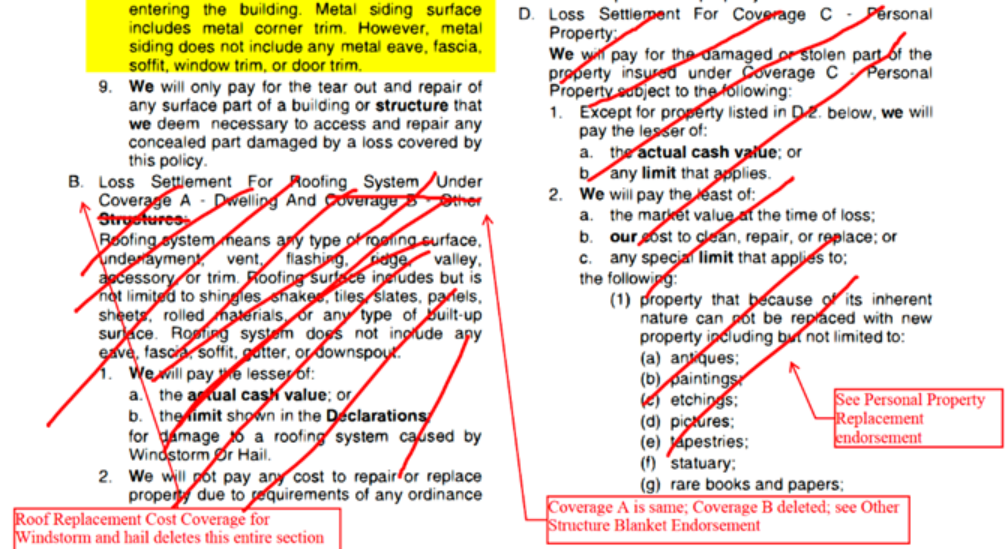
The other experts may have other ideas, but this is how the claims department does it and this is how your client’s adjuster will likely do it. In my opinion, this is the only way to know what the best coverage is and to know what advice to give.
==============================================================================
The best practice in this case is the oft-used insurance slogan: RTFP, which stands for “Read the Full Policy.” As the articles you referenced involving the court cases illustrate, each policy sold may have significant differences in water damage coverage. The best practice is to know your carriers and attempt to sell the form with the broadest water damage coverage. And when you must turn away from your preferred carriers to the E&S marketplace, look at the policies carefully to see how water damage is treated.
========================================================================
I tell my team this: “The policy giveth, the policy taketh away. And occasionally it giveth again, but only under specific conditions.”
How can your staff or insureds understand what a policy provides or excludes unless they’ve read it? Marketing language is never enough. Every policy has exceptions, limitations, and nuances, beyond what can fit on a flyer or a webpage. That’s true across all carriers and all types of coverage, not just State Farm or water losses.
Here’s the approach I use, and it applies to any coverage question:
- Identify the key exposures that matter most for the insured or prospect you’re working with.
- Read the policy carefully and pinpoint significant gaps (places where coverage is limited or excluded for those important exposures).
- Consult with underwriters about endorsements that could address those gaps, and document those conversations in writing.
- Explain the potential gaps to the insured or prospect and suggest purchasing additional endorsements to fill the gaps. Document that discussion in writing as well.
- Confirm the insured or prospect’s final coverage decisions in writing and keep documentation of that confirmation.
- Encourage insured or prospect to read their policies and document that conversation in writing, too.
As insurance professionals, we have a responsibility to understand our products and educate our insureds and prospects. But at the end of the day, the policy is still a contract between the insured and the carrier, and like any contract, the insured has a responsibility to understand what they’re agreeing to.
========================================================================
I suggest obtaining the various water damage exclusion forms and then preparing a document that compares the forms – listing the differences (and possibly that the forms that should not be accepted) in coverage. Supply this comparison to everyone with the instruction that everyone review the forms being used before placing coverage.
========================================================================
I have a tough time believing all insurance companies would take this broad view in excluding coverage. The time period seems pretty subjective.
As far as how to educate your staff regarding water claims and what to tell clients, honesty is always the best policy. It’s unrealistic to review every coverage and exclusion. As an agent, you must let a client know that at least initially, the claim decision rests with the carrier. As an agent, you might disagree with the carrier’s decision and will advocate on your client’s behalf if you disagree.
If they get specific about water claims, I think you could refer to language in the actual policy but also refer to this State Farm court decision. With the risk of sounding like an underwriter or adjuster, each claim stands on its own circumstances. This was an Arkansas court case, so your state might have court cases with a different outcome.
========================================================================
The only way I know is to read the specific policy and examine the wording to see what is covered and what the exclusions are.
========================================================================
As you point out, the policies you work with may be on non-ISO forms, particularly surplus lines policies. Here’s what I suggest:
1. Build a library of the Homeowners coverage forms and endorsements that your carriers are offering, including any surplus lines forms.
2. Check those forms for any wording that differs from or modifies the ISO wording relating to this peril. The ISO wording is in SECTION I – PERILS INSURED AGAINST:
A. Coverage A – Dwelling And Coverage B – Other Structures
1. We insure against direct physical loss to property described in Coverages A and B.
2. We do not insure, however, for loss:
c. Caused by:
(6) Any of the following: (a list of 9 causes follows)
Exception To c.(6)
Unless the loss is otherwise excluded, we cover loss to property covered under Coverage A or B resulting from an accidental discharge or overflow of water or steam from within a:
(i) Storm drain, or water, steam or sewer pipe, off the “residence premises”; or
(ii) Plumbing, heating, air conditioning or automatic fire protective sprinkler system or household appliance on the “residence premises”. This includes the cost to tear out and replace any part of a building, or other structure, on the “residence premises”, but only when necessary to repair the system or appliance. However, such tear out and replacement coverage only applies to other structures if the water or steam causes actual damage to a building on the “residence premises”.
We do not cover loss to the system or appliance from which this water or steam escaped.
For purposes of this provision, a plumbing system or household appliance does not include a sump, sump pump or related equipment or a roof drain, gutter, downspout or similar fixtures or equipment.
Section I – Exclusion A.3. Water, Paragraphs a. and c. that apply to surface water and water below the surface of the ground do not apply to loss by water covered under c.(5) and (6) above.
Watch out for forms or endorsements that change this wording. If you find it in a policy the insured has already purchased, I suggest that you inform the insured and invite them to contact you if they would like you to seek alternative coverage.
Unfortunately, there are many variations to insurance policy language and court interpretations of this language. The “best practice process” is to read every form sold to one of your policyholders and understand the nuances of that language. Then the agent must determine how each insurer may vary as to that insurer’s interpretation of the policy language.
Words matter – but words have perspectives that may be different. For example, how will the insurer interpret “you do your best to maintain heat in the building or structure”? Will setting the thermostat at a minimal level qualify?
How will the claim adjuster interpret “continuous or repeated seepage or leakage of water, or the presence or condensation of humidity, moisture or vapor, which occurs over a period of 14 days or more”?
Will the insurer interpret this that the insured should regularly check for leaks at least every two weeks? And has an insurer modified what might be considered “standard language”? If an insurer has, why?
========================================================================
You are asking us to help you train your staff to be able to explain the legal implications of the various water damage exclusions that might be found in any number of different property policies, and those policies could be “standard” forms, non-“standard” admitted forms, and surplus lines forms.
That would take at least a law degree, and in many cases having just a law degree would be insufficient.
From the articles written by Chip Merlin of the Merlin Law Group, it appears that at least one carrier might be writing exclusions in such a way as to eliminate coverage on paper, and the carrier decides after the fact whether to pay or not pay claims based upon their internal decision process that may have no basis in the contract. Attempting to deal with situations like that opens doors to errors and omissions claims for insurance practitioners.
Depending upon how various carriers configure their exclusions, anything that you see on paper that diverges from a standard ISO or AAIS form might be handled from a, “We don’t know what this carrier might do” perspective, and you could encourage your potential customers to consult their attorneys on these matters. Do not give legal advice on any policy forms.
Copyright © 2026, Big “I” Virtual University. All rights reserved. No part of this material may be used or reproduced in any manner without the prior written permission from Big “I” Virtual University. For further information, contact nancy.germond@iiaba.net.