Ten Ways to More Effectively Manage Creative Insurance Talent
Whether they know it or not, insurance industry executives often fail to effectively nurture and manage their creative talent. Rigid structures and traditional management practices stifle innovation. practices. This article shows ten steps to better understand your creatives to boost your organization’s productivity and the employee’s longevity. This includes providing creatives with proper tools, fostering open communication and understanding their unique working styles.
Managing Creatives: What the Insurance Industry Still Doesn’t Understand
Companies that devalue then lose their creative talent can no longer compete effectively with companies that value and embrace creativity. This is especially true in the insurance industry, whether in underwriting, claims, or the marketing department. Today’s insurance carriers sacrifice creativity in favor of “teams.” Let me tell you a little about my experience as a creative person.
Teams may stifle creativity and kill good ideas in a variety of ways. Creatives often die in teams. They may not feel heard, so rather than continue to speak up, they often disengage.
- Understand that, as left-brained people, your first response to creativity may be resistance. It’s simply too threatening because we feel out of control. Surrender to that lack of control. Don’t embrace knee-jerk reactions; sit with the feelings and thoughts and make decisions only after you tease out what it is you may be resisting. That can be as simple as asking, “What’s my biggest fear here?” Facing our fears can help us walk forward knowing that, yes, this may not be the exact way to go, but it is a way forward and we can make corrections to course if we need to.
- Manage people’s strengths, not their weaknesses. Creative people may be a bit disorganized and scattered. Why do you care if they are producing millions in premium a year? Assign an assistant who keeps them organized. A million people on the job market are excellent organizers and administrators, skilled at creating organization out of chaos. Since the advent of the personal computer, I have seen too many organizations fail to achieve their maximum profit because they refuse to spend money on administrative staff. Just because every desk holds a computer and everyone has an I-phone doesn’t mean everyone is adept at using them.
- Here’s a newsflash — creative people, in contrast with insurance people, often seem, well, a little weird. They dress more eclectically, they may be more open about their own lives, even to the point of making people uncomfortable, or they may be introverts. They stay up late and often trail into work late; they become very animated when they’re in their creative process. They may not have the traditional educational and life path that most people who apply for insurance jobs possess. In short, insurance people can become uncomfortable and judgmental around such creatives. I’ve heard this too many times to count: “ The candidate doesn’t fit our culture.” Read the hyperlinked article if you want to know more about how damaging that mindset is. Stop it. Embrace their creative uniqueness, their thrift-store chic. Celebrate their fashion faux pas and their enthusiasm. Soothe their hurt feelings when they are not included because they are “different.”
- Creative people need their tools. Mine: a comfortable chair, an ergonomic keyboard, my dog at my feet, and my magic wand (I’m not kidding). Some creatives can rarely sit in a chair for long, so if you think your graphic designer should sit in her chair from 7:30 to 4:30 with an hour break for lunch, you may be mistaken. Creatives often wander and talk to people outside their departments, whether from boredom or seeking inspiration. They rarely see silos; they see people who may have ideas they can glean, people to whom they can talk openly. Some of the most creative companies (think Google and Microsoft) have lounge areas in neutral territory with comfortable chairs and couches, customized music, and pool tables where people can hang out and ideas can percolate. Most insurance companies would drop dead in their tracks if someone suggested putting in a few CD players and a ping pong table. I guarantee this: Try it and track your return on investment, because we’re good at tracking the numbers. Watch your profits soar while you remain convinced that people are goofing off. Especially give the work-from-home trend, informational silos are killing today’s insurance corporations. I learned various aspects of my career by eavesdropping on my more experienced colleagues. Kill the silos and watch your profits mount.
- Creatives need sabbaticals. It may be as simple as a three-day weekend or allowing them to telecommute, since they may be most creative late at night anyway. Send them to the art museum for an afternoon or suggest they take a day off and go to the local arboretum or the track to watch the trotters. Coming into the same dull grey cubicle day after day will kill creativity. Just make sure they understand that they need to accomplish projects as quickly as possible, and watch their creative juices flow. Thanks to this understanding manager who let his employee decorate his cubicle, we have this epic photo.
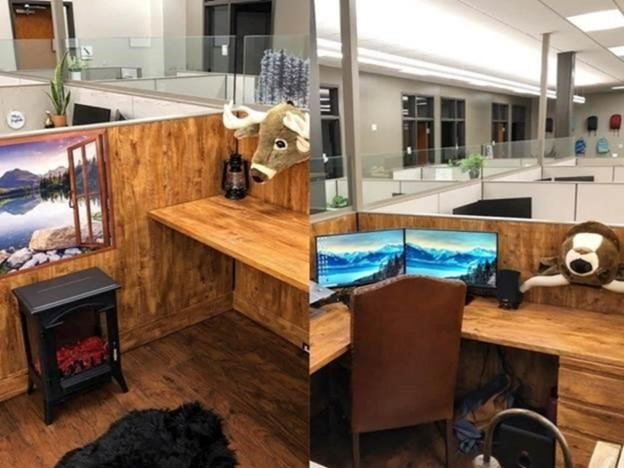
CEO shares employee’s cubicle transformation (Twitter / Mike Beckham / @mikebeckhamsm)
- Protect your creatives from office politics. We’re back to our former point — creatives threaten non-creatives. Non-creatives may throw them under the bus without blinking an eye because they don’t understand them.
- Manager: Do something creative yourself. Did you always want to take a watercolor class? How about quilting? Are you interested in cooking Thai food? Take a class and hang out with some other frustrated creatives. This will do two things: stimulate the creative process and get you out of your insurance rut to meet others who have creative urges. You’ll also begin to understand how the creative process works. It is not always linear, time-bound, or easily understandable to non-creatives. Because creativity does not always run on a nine-to-five schedule, creatives may work into the wee hours of the morning and then fail to appear for that important 9 a.m. meeting. Protect creatives from themselves whenever possible by reminding them of important deadlines, meetings, or other, to them, “mundane” details of office work.
- Most creatives have a line in the sand they will not cross. They may not articulate that line, but they will quit if you push them past it, sometimes with no notice. They’ll just walk out your door. They don’t worry about burning bridges; that’s often way too practical for them. The best way to avoid this is to ensure creatives report to bosses who are the strongest communicators on your management team. This may mean reporting outside their department. I know, that’s threatening, but it’s fine. Creatives often need someone to run interference for them, and their boss must know what’s happening when problems arise or projects derail. This means getting both sides of the story when difficulties arise and then being able to do some conflict management. Managing creatives can be stressful for heavily left-brained people, so don’t let their workstyle stress you out too badly. Rise to the challenge by trying to see the good side of it.
- Creative people may be earning money from their creativity outside your organization. They may be teaching, freelancing their AI skills, writing press releases for non-profits—in short, earning money doing close to what they do for you. Throw away your conflict-of-interest statements when it comes to creatives unless they happen to be working against your interests. One of my friends was hired by a top E&S company, who hired him to speak, write and speak at conferences on their behalf. They then told him what he could write only after shutting down his blog and where he could speak personally and that had legal approve every speech he gave. After a few years, guess what he did? He quit. Today he’s one of the top expert witnesses in insurance. Ask the applicant if you want to know when they walk in the door what they plan to do as a side gig. It is unfair to disrupt people’s lives by hiring them when you are only going to ask them to change. Hire the whole person for what they bring to the table and live with it. If you can’t, don’t hire them.
- The world is changing. I’m not kidding. As one creative, Hugh MacLeod, says, “The stability model of folks who play it safe no longer offers much stability.” Those who see the future like to hang out with creatives. Attend a poetry reading or talk to your friend who teaches to see what young people say about the world. Be bold and think forward. We don’t always like Geico ads, but millions of Americans do. They are bold. Insurance is boring to most people, so hire creative people who can help you get the message out that insurance, while boring, can also be funny and comforting (we pay claims after major disasters) and fair (we sometimes pay claims we don’t owe) and quirky (ever had a few drinks with claims adjusters?). Let your creatives run. You’re paying them to be creative— let them create outside your insurance box and take a few risks with your advertising and marketing, and with your sales team. Let a claims person go with her gut feeling about a claim, and I’ll almost bet she’ll settle it long before the first mediation.
It is highly ironic that we are in the business of risk, yet the last thing we want is an employee who poses ideas with any risk. Stop it. Let your creatives run, not wild, but off the beaten path.
Creativity often clashes with traditional corporate structures, resulting in disengagement and underutilization of talent. I suggest several strategies to foster a supportive environment for creatives.
- Engage in creative activities to heighten your own creativity.
- Manage strengths by providing organizational support, such as dedicated assistants.
- Overcome resistance to change by addressing fears and biases.
- Celebrate creativity, including unique traits and work habits.
- Provide the right tools and flexible workspaces for inspiration.
- Offer creative breaks, sabbaticals, or telecommuting options.
- Shield creatives from office politics and pair them with strong communicators.
- Respect their individuality and outside creative pursuits.
When I began my career, my early claims manager told me this: “Make a decision. Ten more files are coming your way. You probably won’t make a mistake we can’t fix.” One of my favorite expressions that served me in my early days in the industry was this: “I see you got the jackass in the ditch. Let’s not worry about how he got there, let’s figure out how to get him out.” These are great words for a manager to live by, in my opinion.
Let your creatives be them and find their own way—of course, with mentorship. Allowing creatives more freedom, flexibility and boldness can help the insurance industry innovate, connect with audiences, and gain a competitive edge. For an industry rooted in risk assessment, the call is clear—embrace bold thinking and risk-taking to remain competitive in today’s rapidly evolving world.
Copyright © 2026, Big “I” Virtual University. All rights reserved. No part of this material may be used or reproduced in any manner without the prior written permission from Big “I” Virtual University. For further information, contact nancy.germond@iiaba.net.