Big ‘I’ and Future One Release 2026 Agency Universe Study
Big ‘I’ and Future One Release 2026 Agency Universe Study
ALEXANDRIA, VA, September 23, 2026 —The vast majority of independent insurance agencies report profitability across both personal and commercial lines, with significantly fewer reporting revenue decreases compared to 2024, according to the 2026 Agency Universe Study.
Meanwhile, amid growing adoption of artificial intelligence (AI), independent agents are increasingly investing in marketing, hiring and emphasizing value rather than price.
Future One, a collaboration of the Big “I” and leading independent agency companies, has released key findings from the recently completed Agency Universe Study, hailed as the most comprehensive look at the independent agency system.
“Independent agencies are successfully navigating a changing insurance landscape and the surge of AI,” says Charles Symington, Big “I” president & CEO. “This study illustrates a distribution channel that remains stable, resilient and well-positioned for the future. As the market evolves, agencies are investing in AI and other technologies without losing sight of what distinguishes the channel: trusted advice, choice and personal relationships.”
The study looks at statistics about independent agencies operating in the U.S., including their numbers, revenue base and sources, number of employees, ownership, mix of business, diversification of products, technology uses, non-insurance income sources and marketing methods.
“The Agency Universe Study remains the most empirical look at the largest insurance distribution channel in America: the independent agency channel,” says Jennifer Becker, Big “I” senior director of agent development, research and education. “This year’s study provides a unique barometer on the agency system as it evolves around technology, softer markets and perpetuation.”
Key findings from the 2026 Agency Universe Study include:
- Independent insurance agencies total an estimated 37,000. The number of agencies represents a small decrease from 2024, with the number continuing to remain relatively stable over the last decade.
- Average size of agency staff is larger than in 2024. On average, agencies report 9.9 staff members across all positions, up from an average of 8.2 in 2024. While 1 in 3 agencies say their employee count has increased in the past two years, hiring depends on size. Small agencies are least likely to have added employees, while jumbo agencies are most likely.
- Three in 4 agencies saw revenue increases between 2024 and 2025, on par with 2024 survey results. However, significantly fewer report a decline in revenue in 2025, down from 12% to 8%. About 7 in 10 agencies report increases in personal lines revenue and 2 in 3 in commercial lines revenue from 2024 to 2025.
- Agencies’ total marketing budget in 2026 is higher than in 2024. Average budgets rose from $14,300 in 2024 to $20,600 in 2026. Social media and digital marketing lead the most cited marketing activity, with 47% ranking it as their top activity. It is followed by Google Business, search engine optimization (SEO) and websites. Facebook still dominates channels (70%), ahead of Instagram (46%) and LinkedIn (35%).
- Nearly half (46%) of agencies report using AI, up significantly from 15% in 2024. Uses include marketing content generation (49%), coverage form analysis (43%) and contract reviews (35%). Lack of knowledge about capability (60%) and security and privacy (48%) were the top two barriers to AI adoption, both increasing by 10% compared to 2024.
- Hiring, technology and personal lines challenge agents. Top challenges overall for agencies were finding and screening job candidates with strong potential (45%); keeping up with the latest in AI (43%), which was a new entry; and growing personal lines business (41%). As the market softens, concerns about carriers’ market commitment eased to 41%, down from 56% in 2024.
The biggest technology challenge for agencies was, as in previous years, dealing with multiple carrier interfaces. - The personal touch remains a core piece of the agency value proposition. Most agents (86%) continue to prefer that customer service go through their agency via phone or other non-online methods. Less than a quarter prefer online self-service via a carrier website or app. However, agencies are comfortable with self-service options for policy documents, billing and claims, but not for purchasing policies or obtaining quotes.
Further, more than half (57%) agree that their agency has placed more focus on customer experience. Also, 57% say there is a significant need for training to help customer service representatives (CSRs) and producers sell on value rather than price.
The Agency Universe Study was first conducted in 1983. Since 2002, the study has been completed biennially. Since 2004, the Agency Universe Study has relied on internet data collection. In total, 1,376 respondents were included in the 2026 study, conducted by Zeldis Research in cooperation with Future One.
In addition to the Big “I,” the Future One coalition includes the following company partners: Allstate Insurance, Amerisure, Central Insurance Companies, Chubb, CNA, Foremost, a Farmers Insurance Company, GEICO, Hartford Steam Boiler (HSB), Liberty Mutual Insurance, Main Street America Insurance, National General, an Allstate Company, Nationwide Insurance, Progressive, Selective Insurance, Travelers, Westfield Insurance.
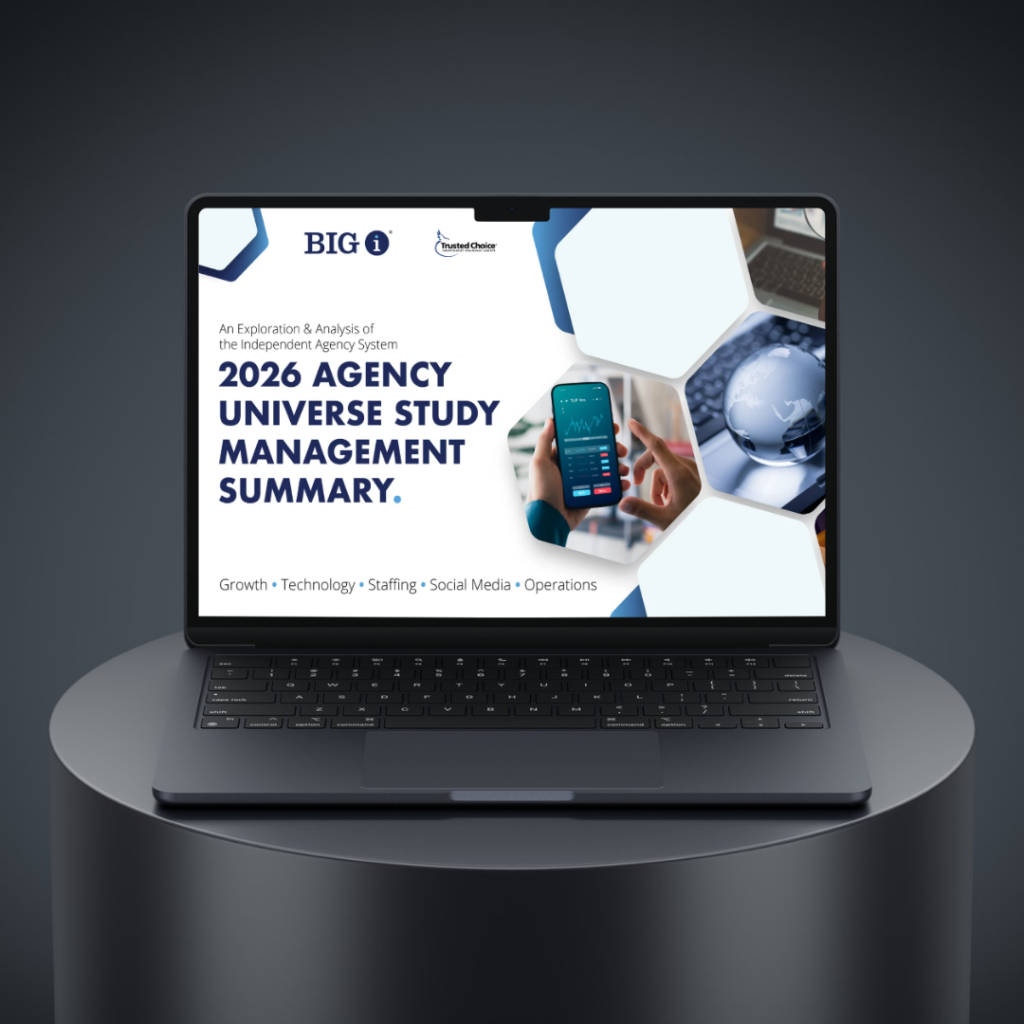
To order a copy of the 2026 Agency Universe Study Management Summary, which provides an overview of the highlights from the complete study, visit the Big “I” Agency Universe Study webpage.
For a press copy of the summary, reach out to Will Jones (william.jones@iiaba.net), Big “I” director of communications.
Founded in 1896, the Independent Insurance Agents & Brokers of America (the Big “I”) is the nation’s oldest and largest national association of independent insurance agents and brokers, representing more than 25,000 agency locations. Big “I” members are trusted insurance advisors who offer consumers all types of insurance—property, casualty, life, health, employee benefit plans and retirement products—from a choice of insurance companies.