Discover the Endorsement and Exclusions Filing Trends for 2026
Did you ever wonder what the carriers are up to? According to one group of experts at Insuraviews, a lot of change is afoot, at least with coverage enhancements, exclusions and form filings. Read this article for an overview and a link to Insuraviews’ insightful webinar. Of course, artificial intelligence exclusions lead the pack, but there’s much, much more. Whether you are an agent, an expert witness, or a risk manager, read on.
The Big “I”s Technical Affairs Committee meets annually with Verisk, but we are a forward-looking bunch, hoping to make changes to current forms or suggest new forms to meet current societal needs. (Remember, insurance is there to serve society.) However, if you ever wondered what the insurers are really up to, then consider following Insuraviews, which “turn insurance rate filings into real-time intelligence.” Sound fascinating? Read on.
What Does Insuraviews Do?
According to their website, Insuraviews helps to “turn insurance rate filings into real-time intelligence.” Their team collects rate, rule and form filings across the property casualty market in all 50 states and DC, turning these filings into searchable intelligence. According to its website, while it’s built for P&C carriers, agents can follow these trends to learn what coverage changes may be on the horizon.
According to Insuraviews’ website, they convert the rate filings into “structured data,” including the following.
- Rate impact
- Affected policyholders
- Premium changes
- Methodology
- Rational
Their artificial intelligence assistant provides search answers in “seconds.” Apparently highly rated by carriers for their time saving and accuracy, agents can also benefit by using this as a tool to find which endorsements and exclusions may be on the horizon that will impact your clients and possibly, if you are unaware of these changes, your errors & omissions claims.
Not only did their webinar look at exclusions, but it also reviewed where coverage will expand. Their data analyzed over 40,000 forms filed from January 1, 2026, through April 21, 2026; 13,000 in January alone.
What Carriers are Filing in 2026
No surprise, generative AI is a “very big topic” in 2026. The top filing carriers included Liberty Mutual, Great American, Travelers, Berkshire Hathaway and CNA. The data included in the webinar were endorsements or policy form amendments, not rate, actuarial, or policy jacket flings. The presenters labeled the carriers as “proactive,” filing early in the year so they can be ready for major renewal cycles. Language is “shifting in real time,” according to one of the presenters.
Note to agents and brokers, watch your renewals carefully. According to the presenters, 38% of the filings were exclusions, double that of coverage extensions. If you don’t recognize a form or see a new filing date on a form that you’re familiar with, read the form and compare it with the prior version on the policy. Alert your customers to any changes in forms that can limit or enhance coverage.
Top Trending Exclusions
Here is a breakdown of trending filed exclusions.
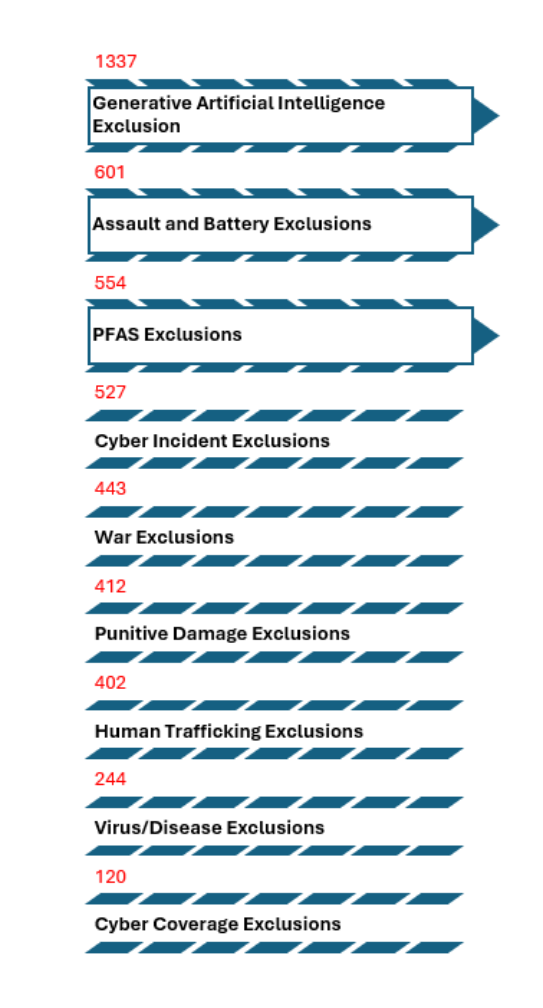
Of note is one of the presenters’ thoughts on these exclusions. First, approximately 15,000 of the filings are exclusions, “about double of that of the coverage extensions.” She went on to say, “We’re seeing a lot of defensive moves…” And further, “This snapshot shows an industry that’s in a very reactive, protection-first mode, leaning heavily on exclusions to manage a whole new generation of complex risks.”
Gen AI Exclusions
Insurers filed about 40% of gen AI exclusions under commercial umbrella and excess liability lines. However, the presenters warned, while the “insurers [were] protecting their top-layer exposures first,” these exclusions will no doubt soon trickle down to the primary carriers.
There is a new focus under Coverage B, Personal & Advertising Injury, to address the prevalence of deepfakes, synthetic media (artificially manipulated text, images, audio, video) and intellectual property infringements. One such case, Barkley& Associates, Inc., vs. Quizlet, Inc., is litigation alleging copyright and trademark infringement. The complaint alleges that Quizlet, an exam-study platform, used its proprietary test prep materials on content created by Barkley & Associates, publishes nurse practitioner exam guides.
Not All Carriers Use Verisk Language
Not all insurers rely on Verisk gen AI definitions. Increasingly, according to Insuraviews presenters, filings define gen AI in policy language, and these definitions include large language models, image generators and autonomous agents. A standard chatbot may not be an autonomous agent. A standard chatbot is an informational tool while an autonomous agent is similar to a digital employee with broad system access. There will no doubt be litigation surrounding these definitions. When not defined in the policy, courts normally rule that a dictionary definition or common usage applies.
This language developed could result in “a total exclusion for any loss where AI played a role,” a presenter said. The definitions across filings align with ISO language: “Generative artificial intelligence means a machine-based learning system or model that is trained on data with the ability to create content or responses, including but not limited to text, images, audio, video or code.”
Although not covered in this webinar, at least one carrier has released a proprietary AI exclusion that is an absolute exclusion. As agents, we should never assume policy language is standard ISO unless we verify the form number and the edition date.
Other Lines Impacted by Gen AI
There are also exposures for employment practices liability insurance (EPLI) and directors’ and officers’ insurance. Wrongful termination and biases created by Gen AI, such as health-care coverage decisions, can impact coverage in those lines.
According to the presenters, “This is not just a trend; it’s looking like a coordinated market adjustment.” Carriers are working “aggressively” to manage this risk before losses hit their portfolios, she continued. Seven insurers account for over 60% of these filings, including Liberty Mutual and AXA. Those two alone accounted for almost 28% of the filings. This suggests “coordinated form development and ISO influence rather than independent market innovation.” The presenters believe these exclusions lean heavily on ISO language introduced recently.
Whether language developed by advisory agencies such as Verisk/ISO is easier to defend than proprietary language is always a matter of speculation.
High Regulator Approval Rates
Regarding regulators, Insuraviews’ presenters have seen a regulatory approval rate of over 41% and an out-and-out disapproval rate of less than 1%, presenters explained. Generally, “You see a much higher disapproval rate with new introductions like this to the market.” In her opinion, “Regulators are viewing these exclusions as … a standard risk management tool rather than a restriction of coverage.”
Noted by the presenters is the fact that the definitions fail to differentiate between internal AI tools and third-party AI services, creating a “broad sweep” at claim time, they predicted.
Some carriers apply the exclusion broadly to all general liability while some focus on excluding personal & advertising injury coverages. The presenters do not rule out future demands by regulators for more specific language.
Per- and Polyfluoroalkyl Substances (PFAS) Exclusions
There were 554 PFAS exclusions filed in the first few months of 2026, largely appearing with legacy pollutions exclusions. Notably, errors & omissions and professional liability coverages had 146 of these filings, presenting a heightened risk to consultants, engineers and environmental consultants.
Insurers are moving to absolute exclusions, according to the presenters. “If it’s waterproof, grease proof, or non-stick, it’s probably on this [EPA] list.”
Reasons for States’ Rejections
State regulators’ rejections to AI exclusions from state regulators were the following, according to the presenters.
- Overly broad exclusionary language
- Inadequate or missing definitions of gen AI
- No duty to defend language, which regulators often see as an “overreach”
- Emerging state AI laws create inherent conflicts
Cyber Incident Exclusions
Non-cyber line forms are beginning to exclude cyber as the cyber risks have grown rapidly in the U.S. Some carriers, however, are offering buy-back cyber coverage.
Another note to agents: Businessowners policies (BOPs) may provide the impression of some cyber coverage. However, that coverage is minimal, and all quotes for BOPs should include an offer to quote a cyber standalone policy. Using this standard approach can help reduce an E&O allegation of, “You mean I could have bought a cyber policy? You never offered me that coverage!”
War and Armed Conflict Exclusions
A great deal of language is evolving addressing cyber warfare, heightened by drone warfare conflicts. Precedents are being set with cyber-attacks that damage infrastructure, which has increased the fear of state-sponsored attacks. With ongoing global conflict and state-sponsored cyber-attacks, insurers want to be ahead of the curve.
Previously, without a war exclusion, business interruption, data restoration, system recovery, notification costs and third-party liability from a data breach were typically covered. Under new war language, this language has new exclusions and gray areas where coverage may apply.
“…injury or damage arising directly or indirectly from war, warlike actions by military forces, insurrection, rebellion, revolution, or usurped power – regardless of the means used, including cyber means.” Additional language: “…including actions taken by governmental authority in hindering or defending against any of these events, by any means including cyber means, computer virus, or other electronic attack.”
The problem is that state-sponsored attacks are typically executed by non-state proxies, according to the presenters.
Carriers filed most of these exclusions in their umbrella/excess layers.
Human Trafficking Exclusions
Carriers filed more than half of these exclusions in the umbrella and excess coverage lines. According to the presenters, much of this is driven by tort reforms. Hotel organizations, transport companies and staffing businesses can face allegations of allegedly colluding with or ignoring the signs that human trafficking was occurring.
Thirty states have expanded civil liability for “facilitators” or organizations that were “in some way complicit in preventing…” human trafficking from occurring, according to the presenters.
Coverage Expansions Amid a Softening Market
It’s not all bad news. The webinar noted several commercial lines coverage extensions and endorsements. These include the following.
- Cyber coverage extensions that help in commercial package and BOP policies for small businesses who find cyber standalone coverage unaffordable.
- In auto policies, expanded roadside coverage and telematics-linked dispatch services and EV charging assistance.
- On D&O coverage, built-in sublimits for shareholder books-and-records demands, which is a frequently used tactic by activist investor-related litigation.
- In D&O and EPLI, sublimits for shared defense costs in multi-defendant liability claims.
- In commercial property, allegedly as a response to inflation, tiered replacement-cost options at 125% to $150% of policy limits with automatic inflation guard.
- In commercial liability, increased coverage for active shooter and workplace violence events, including crisis response, counseling, premises restoration and public relations costs. This can help bridge the coverage gap between the standard CGL and standalone active assailant policies.
- A note to agents: Watch the definition of the qualifying event since it may limit the type of event by weapon. In some cases, the standalone policy’s definition may be broader than the CGL’s enhancement.
Personal Lines Coverage Enhancements and Exclusions
Most filings on homeowners’ forms were coverage enhancements. They include the following.
- Extended replacement costs of 25%, 50% and guaranteed replacement cost with no cap. This is no doubt in response to post-inflation widespread underinsurance.
- Generative AI exclusions now appear in some states on personal injury arising from AI-gen content.
- Fungi or bacteria exclusions now concentrated in Idaho, Illinois and New Mexico and
“bundled with” mold and water damage language. - Home cyber protection endorsements can now extend coverage for cyber-attacks, extortion, cyber bullying responses and online fraud as a modular addon.
Here are some enhancements on personal auto.
- Broad enhancement package endorsements that replace multiple coverages into a single endorsement.
- Gap coverage increases to cover the difference between actual cash value (ACV) and outstanding loan balance at loss.
- Newer or lower-mileage vehicle valuation at total loss rather than depreciated ACV.
- Electric vehicle coverage protecting external charging equipment. Also added definitions for plug-in hybrids and battery electric vehicle definitions.
- Roadside assistance improvements, including mobile charging and towing to the nearest charging station.
While it seems in many lines of coverage, exclusions outnumber coverage enhancements, in personal lines, the trend appears reversed.
Exclusions Filings by Line of Business
Here are the following lines of business impacted, as well as how many filings Insuraviews evaluated earlier this year.
| Commercial Umbrella/Excess | 5,498 |
| CGL | 2,389 |
| Other Liability | 2,156 |
| Commercial Package/BOP | 1,487 |
| Commercial Auto | 748 |
| Commercial Property | 412 |
| D&O | 358 |
| Professional Liability | 342 |
| EPL | 290 |
| Homeowners | 178 |
As the presenters pointed out, the top half of the list is almost all liability lines, and the “heavy lifting” on these exclusions is occurring on the commercial side. Although not specifically stated, I’m thinking the threat of nuclear verdicts and class actions suits, as well as “we just don’t know what’s coming with gen AI,” may be the driver behind many of these carriers’ actions.
What’s Ahead for Filings?
Here’s what the presenters predict to watch for on form filings in 2026 and 2027.
- Much like cyber, the presenters believe carriers will “split” AI exclusions into blanket exclusions and those allowing coverage carve-backs for disclosed and auditable AI use.
- Expect to see more modular cyber add-ons to standard lines policies, allowing customers to avoid buying standalone cyber coverage.
- Social inflation concerns continue to plague the industry, as shown perhaps by punitive damages filings, assault and battery exclusions and human trafficking exclusions.
- State-level PFAS regulatory actions will continue to impact future PFAS filings.
- The presenters anticipate a big demand in standard markets for parametric weather triggers, wildfire defensible-space endorsements and flood gap coverage given urban flood risks will enter the standard markets.
- Autonomous vehicle forms will emerge in the next 12-to-24 months with new allocation of fault and product liability language, they predict, as fully autonomous commercial vehicles appear.
Here are the presenters’ five key takeaways they see from rate filings they review.
Gen AI is “reshaping every coverage line.” Gen AI exclusions are “the fastest-moving form development since cyber.”
There is a new era of multi-hazard exclusion bundling, impacting PFAS, cyber, war, AI and human trafficking.
Umbrella/excess saw 5,400 exclusion filings in their lines. “Top-layer carriers are moving first, and primary markets will follow their lead.”
Innovative coverage is growing alongside exclusion activity.
Regulation is accelerating form filings. PFAS/EPA, state AI laws and human trafficking legislation are compelling insurers to adapt and update forms. As much as loss experiences have driven filings in the past, compliance is now an equal driver.
Words of Caution to Agents
The most important task you can undertake this year is to revise your new policy issuance and your renewal procedures.
- Review the dec sheet and attachments closely.
- Ensure the carrier or managing general agency has attached the appropriate endorsements with the appropriate dates.
- Review any new endorsements, including policy definitions.
- Ensure the edition dates have not changed on renewals, and if they have, review that endorsement carefully.
Filing a Form Does Not Mean Immediate Implementation
Whether it’s an exclusion or a policy enhancement, when carriers file a form with a state regulatory agency, it does not guarantee the insurer will use it. Filing the form simply allows that state’s regulatory agency to grant legal and regulatory approval for its use. Think of form filing as a strategic move, a “back-pocket tool” in case carriers need it.
Why do insurers file these forms? Here are some of the reasons.
- Keeping options available to the carrier. Companies often file a “bucket” of exclusions or enhancements to prepare for emerging risks or to standardize policy language. They lock in the ability to use these filings. However, they may only apply them to accounts with high-risk profiles, or if legal issues arise that their forms might help solve.
- Diverging state approval timelines. Under ‘file-and-use” laws, a carrier can use a form assuming it is automatically approved if the state doesn’t reject it within a set timeline. Insurers may file early to start that clock, even before they’re ready to implement.
- Creates a competitive edge. Filing an enhancement such as we’re seeing now on some property lines allows an insurer to offer broader coverage right away to win a new account or to better compete without waiting for approval.
- To manage emerging risks. As in the case of generative AI risks, the future is quite uncertain. As our webinar participants said, there has never been this much activity around an issue such as Gen AI since cyber issues burst on the scene.
Approval doesn’t mean carriers rush to apply those forms. Underwriters treat these forms as tools, applying them case-by-case to manage risk. However, in the case of Gen AI, presenters predicted that the carriers providing higher layers of coverage will no doubt determine when they will apply them, so watch for them.
To watch this interesting interview, visit this link.
Copyright © 2026, Big “I” Virtual University. All rights reserved. No part of this material may be used or reproduced in any manner without the prior written permission from Big “I” Virtual University. For further information, contact nancy.germond@iiaba.net.