The State of America’s Roofs: How Today’s Roof Risks Cause Problems for Insurance Agents and Building Owners
The latest U.S. roof risks data provided by Verisk in their report 2025 “Tracking Roofing Trends, Replacement Costs, and More” using US data shows roof-related losses remain a major issue for insurers, insureds and agents alike. In 2025, roof replacement cost reached $23 billion. Simultaneously, aging roofs, higher deductibles and the increasing tool of applying non-recoverable depreciation to roof claims through roof schedules are changing both underwriting and client expectations. For insurance agents, your opportunity is clear: create a method to proactively educate your insureds about the importance of their roof condition, coverage terms, roof maintenance and mitigation before they experience a claim.
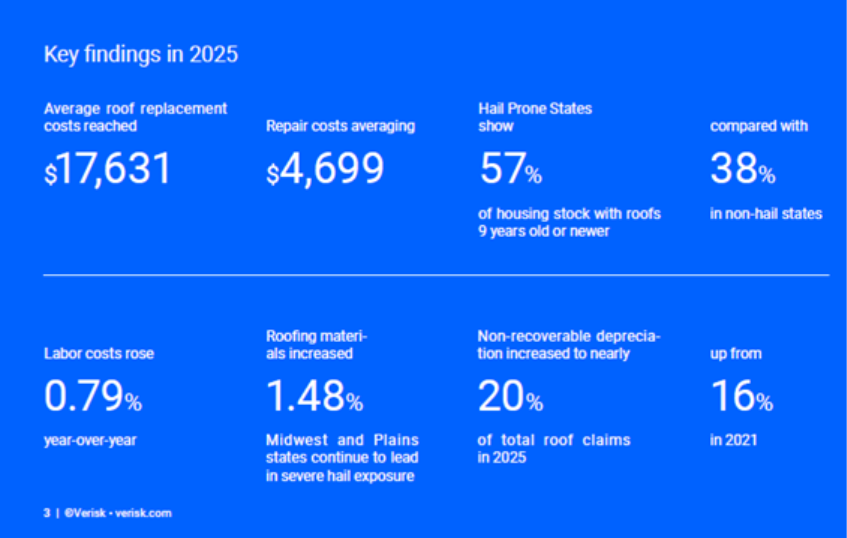
In 2025 according to Verisk in their 2025 report “Tracking Roofing Trends, Replacement Costs, and More,” roof replacement cost reached $23 billion in 2025, average replacement costs climbed to $17,631, and severe hail impacted 20% or more of roofs in 16 states. Roof risks are troubling coverage areas that impact not only the homeowner, but the insurance agent who may face significant backlash and even an errors & omissions (E&O) allegation after a roof damage claim.
I recently followed a discussion on Next Door, a neighborhood app used to talk about issues such as local crime, vendor performance and other neighborly issues. One of the participants listed a direct writer that now introduced a roof actual cash value (ACV) schedule. “I’ve been with this company for 12 years,” he said, “and never had a claim. I’m finding another insurance company.”
As carriers have begun to introduce roof schedules, which pay a depreciated amount based on the age of your customers’ roofs, agents should help educate their clients before a roof loss occurs. Roof risk directly affects loss ratios, client retention and even your E&O exposure.
According to the Verisk report, non-recoverable depreciation “…as a percentage of total assignments of all roofing claims increased to nearly 20% in 2025.” This “steady climb” reflects the increased age of today’s roofs and more importantly, “…carriers’ increasing focus on actual cash value settlement strategies.” Explain that to upset customers who may have to borrow money to replace their roof at settlement time.
Hail a Predominate Cause of Roof Damage
Hail catastrophe claims costs were largely driven by increased hail claims, with 33% of roofing claims coded as catastrophe hail. This makes this issue widespread rather than only a regional concern. Notably, in 2025, wind claims decreased slightly from previous years with only 19% of all roofing claims coded as catastrophe wind.
The 2025 U.S. Roof Report reveals roof age, underwriting risk, and settlement pressures — and how independent agents can turn this data into an advisory advantage.
The Climbing Cost of Roof Claims
Roof claims now cost the industry $23 billion in replacement cost value (RCV) nationally, much of it from hail damage, with an average roof replacement cost of $17,631.
Increasing roof claim severity affects carrier appetite, renewal pricing and client satisfaction.
If agents fail to address their insureds’ roof conditions with both applicants and renewing clients, agents may face a disgruntled customer who does not understand why the insurer will not write their building or home until they replace their roof. Let’s face it, few insureds today can afford to replace their roof out of their savings and may have to resort to a home equity loan or other borrowing to buy a new roof.
Adding a roof schedule to existing clients or not disclosing a roof schedule to new clients or to existing insureds when the carrier places the schedule at renewal, can expose agents to an E&O claim.
This Huffington Post article provides some insight into how roof schedules and subsequent deductions work. While some carriers may apply roof scheduled depreciation to all roof claims, some carriers apply them only to wind and hail losses.
Key Findings In 2025 From the Verisk Roof Report
Hail Damage Is a Countrywide Risk
Hail damage is becoming only more frequent, as most agents know from the claim reports they field. And often, insureds don’t learn of hail damage until a roofer canvassing a neighborhood offers to give your clients a “free roof inspection.” We insurance agents know where that leads.
Hail is no longer a regional problem. Sixteen states now experience significant hail impacts. In one example, the report shows a difference in regional roof patterns. In the eastern US, there are more roof condition issues due to adverse weather. In the western region with less weather volatility, roofs are in better overall condition. In hail-prone states, asphalt roofs average a 15-year life. In the Western states of Utah, Nevada and Arizona, they average 22 years. And a hail event now becomes more damaging, according to Verisk, due to aging roofing materials and changing climate patterns. Roofs with fewer than five years of remaining service life may incur up to 50% more damage during severe weather than roofs with more than eight years of useful life remaining. That difference is significant.
The Underwriting Push for Better Roof Data
Do you wonder why today’s underwriters place such significance on roof condition? Have you had a risk rejected because the underwriter mistakenly believes your insured’s roof is a “torch-down, which we won’t write”?
Closer scrutiny of roof age and quality significantly impacts the amount carriers pay. According to one AON report, severe convective storms became a “dominant driver of insured catastrophe losses in the US.” There are few tools available to insurers to limit claims payouts, so valuing roofs at actual cash value rather than replacement cost has become a post-loss tool. However, there is an old saying, “When all you have is a hammer, everything looks like a nail.”
What else have carriers done to limit payouts and improve underwriting results?
Here are just a few of the tools now used by underwriters.
- Higher percentage deductibles, especially on commercial roofs
- Asking for proof of roof age prior to binding coverage
- Requiring roof certification or roof inspections, especially on older homes
- Exclusions limiting or excluding coverage entirely for cosmetic-type losses where the loss does not compromise the roof’s integrity
- More wear and tear coverage rejections
Roof age and roof condition now rank high in influencing underwriting eligibility. 29% of asphalt roofs in the US are near their end-of-life, according to Verisk. There is no doubt your underwriters will request many more answers on asphalt roofs. You will undoubtedly face some of these other issues as you submit new or renewal applications, whether on personal or commercial business, and on roofs in general, not just asphalt roofs.
Claims Settlements Now Impact Insureds’ Out-of-Pocket Costs
According to Verisk, in 2025, non-recoverable depreciation averaged 20% of the claim cost. This can be a significant shock to your insured, increasing customer frustration and client retention. Failure to walk your insured through policy limitations pre-loss can present an E&O issue.
It is imperative that you review renewal business for any new limitations in coverage, including roof depreciation schedules. On new business, discuss roofing loss limitations with your insured before the hail hits the fan. before the hail hits the fan.
Turning Roof Condition into Your Advisory Advantage
Whether you quote against a direct writer or renew a policy, ensuring you explain any roof issues with your clients can position you as a trusted adviser. Do you know which carriers you compete against that now place actual cash value roof endorsements on all policies? Knowing this helps you defend against the “price is the most important factor” argument.
Beyond the scope of this article is the FORTIFED roof standard, one many underwriters now consider with both new and renewing risks. The Insurance Institute for Business & Home Safety (IBHS) FORTIFIED roof standard is voluntary, above-code standard designed to ensure homes and commercial buildings are more wind, hail and other peril resistant. These standards include stronger connections to keep the roof attached to the building, a sealed roof deck, impact resistant roof coverage, wind-and rain-resistant attic vents and more. A roof built to FORTIFIED standards may attract more carriers to your risk.
Furnishing Roof Information an Important Way to Distinguish Yourself as a Trusted Advisor
With more insurers changing the way they underwrite and pay claims on roofs, your ability to explain today’s underwriting demands to your insureds can set you apart from other agents. As a Trusted Choice independent agent, the more information you can provide to an existing or potential client, the more they trust that you are in their corner. You also protect yourself against an E&O claim if a roofing claim causes an insured to face a large additional cost or a claim denial when they face a roof damage claim.
To download the full Verisk roof report, visit this link.
Copyright © 2026, Big “I” Virtual University. All rights reserved. No part of this material may be used or reproduced in any manner without the prior written permission from Big “I” Virtual University. For further information, contact nancy.germond@iiaba.net.